
Neodymium(III) chloride hexahydrate
- CAS NO.:13477-89-9
- Empirical Formula: Cl3H12NdO6
- Molecular Weight: 358.69
- MDL number: MFCD00149801
- EINECS: 629-622-6
- SAFETY DATA SHEET (SDS)
- Update Date: 2025-01-27 09:38:02
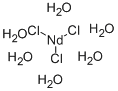
What is Neodymium(III) chloride hexahydrate?
Chemical properties
purple crystals, crystalline powder or chunks
The Uses of Neodymium(III) chloride hexahydrate
Neodymium(III) chloride hexahydrate may be used as a source of Nd3+ ions, to be used to dope AgBr crystals, known to exhibit lasing effects.
What are the applications of Application
Neodymium(III) chloride hexahydrate is an inorganic catalyst
What are the applications of Application
Neodymium(III) Chloride is a typical starting material for the production of Nd metal. It is also used a a source of Nd3+ ion for doping into laser host materials.
Health Hazard
Neodymium(III) chloride hexahydrate does not seem toxic to humans and animals (approximately similar to table salt).
Purification Methods
Neodynium chloride forms large purple prisms from concentrated solutions of dilute HCl. They are soluble in H2O (2.46 parts in 1 part of H2O) and EtOH, and lose H2O at 160o.
Properties of Neodymium(III) chloride hexahydrate
| Melting point: | 124 °C(lit.) |
| Density | 2,282 g/cm3 |
| storage temp. | Inert atmosphere,Room Temperature |
| solubility | soluble in ethanol |
| form | crystal |
| Specific Gravity | 2.282 |
| color | purple |
| Water Solubility | 2.46 parts per 1 part H2O [MER06]; soluble alcohol [HAW93] |
| Stability: | hygroscopic |
| CAS DataBase Reference | 13477-89-9(CAS DataBase Reference) |
Safety information for Neodymium(III) chloride hexahydrate
| Signal word | Warning |
| Pictogram(s) |
 Exclamation Mark Irritant GHS07 |
| GHS Hazard Statements |
H315:Skin corrosion/irritation H319:Serious eye damage/eye irritation H335:Specific target organ toxicity, single exposure;Respiratory tract irritation |
| Precautionary Statement Codes |
P261:Avoid breathing dust/fume/gas/mist/vapours/spray. P264:Wash hands thoroughly after handling. P264:Wash skin thouroughly after handling. P271:Use only outdoors or in a well-ventilated area. P280:Wear protective gloves/protective clothing/eye protection/face protection. P302+P352:IF ON SKIN: wash with plenty of soap and water. P305+P351+P338:IF IN EYES: Rinse cautiously with water for several minutes. Remove contact lenses, if present and easy to do. Continuerinsing. |
Computed Descriptors for Neodymium(III) chloride hexahydrate
Neodymium(III) chloride hexahydrate manufacturer
New Products
4,4-Difluoropiperidine hydrochloride tert-butyl 9-methoxy-3-azaspiro[5.5]undecane-3-carboxylate Indole Methyl Resin N-Isopropylurea N,N-Dicyclohexylcarbodiimide(DCC) MELDRUMS ACID 5-METHYLISOXAZOLE-4-CARBOXYLIC ACID Magnessium Bis glycinate Zinc ascorbate 1-bromo-2-butyne 2-acetamidophenol 9(10H)-anthracenone Erythrosin B, 4-Piperidinopiperidine 2-((4-morpholinophenylamino) (methylthio) methylene) malononitrile 2,4-dihydroxybenzaldehyde 3-(4-morpholinophenylamino)-5-amino-1H-pyrazole-4-carbonitrile Methyl 2-methylquinoline-6-carboxylate 2,6-dichloro-4-nitropyridine 4-Bromo-2-chlorobenzonitrile 2-(benzylamino)acetic acid hydrochloride 4-(tert-Butoxycarbonylamino)but- 2-ynoic acid 3,4-dihydro-2H-benzo[b][1,4]dioxepine 1-Phenyl-1-cycloprppanecarboxylicacidRelated products of tetrahydrofuran



You may like
-
 Neodymium(III) chloride 99%View Details
13477-89-9 -
Neodymium (III) Chloride Hexahydrate extrapure CAS 13477-89-9View Details
13477-89-9 -
Neodymium(III) chloride, hexahydrate, GR 99.9% CAS 13477-89-9View Details
13477-89-9 -
Neodymium(III) chloride hexahydrate CAS 13477-89-9View Details
13477-89-9 -
3-(4-amino-1-oxoisoindolin-2-yl)-1-methylpiperidine-2,6-dione 98%View Details
-
20677-73-0 (2,2-diethoxyethyl)methylamine 98%View Details
20677-73-0 -
3-(4-(hydroxyamino)-1-oxoisoindolin-2-yl)piperidine-2,6-dione 98%View Details
-
57381-49-4 2-bromo-4-chlorobenzonitrile 98%View Details
57381-49-4
Statement: All products displayed on this website are only used for non medical purposes such as industrial applications or scientific research, and cannot be used for clinical diagnosis or treatment of humans or animals. They are not medicinal or edible.