
Boron trifluoride-acetic acid complex
- CAS NO.:373-61-5
- Empirical Formula: C4H7BF3O4-
- Molecular Weight: 186.9
- MDL number: MFCD00036359
- EINECS: 206-768-5
- SAFETY DATA SHEET (SDS)
- Update Date: 2025-09-25 17:15:13
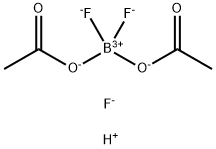
What is Boron trifluoride-acetic acid complex?
Chemical properties
colourless liquid
The Uses of Boron trifluoride-acetic acid complex
It is an important raw material and intermediate used in Organic Synthesis, Pharmaceuticals, Agrochemicals and Dyestuff. It is also used as a desilylating agent. It is also been used in the protodesilylation of the phenyl group as part of the conversion of the dimethylphenylsilyl group into a hydroxyl group with retention of configuration.
Flammability and Explosibility
Non flammable
Properties of Boron trifluoride-acetic acid complex
| Melting point: | -47 °C |
| Boiling point: | 140-148 °C |
| Density | 1.353 g/mL at 25 °C(lit.) |
| vapor pressure | 95Pa at 20℃ |
| RTECS | ED2280000 |
| refractive index | n |
| Flash point: | 183 °F |
| storage temp. | Store below +30°C. |
| form | Liquid |
| color | Clear light yellow to yellow-brown |
| Water Solubility | reacts |
| Sensitive | Moisture Sensitive |
| BRN | 3686177 |
| Exposure limits | ACGIH: TWA 2.5 mg/m3 NIOSH: IDLH 250 mg/m3 |
| Stability: | Stable, but moisture sensitive. Incompatible with water, moist air, metals, strong oxidizing agents. Store under dry atmosphere. |
| EPA Substance Registry System | Borate(1-), bis(acetato-.kappa.O)difluoro-, hydrogen fluoride (1:2:1), (T-4)- (373-61-5) |
Safety information for Boron trifluoride-acetic acid complex
| Signal word | Danger |
| Pictogram(s) |
 Corrosion Corrosives GHS05  Exclamation Mark Irritant GHS07 |
| GHS Hazard Statements |
H302:Acute toxicity,oral H314:Skin corrosion/irritation |
| Precautionary Statement Codes |
P270:Do not eat, drink or smoke when using this product. P280:Wear protective gloves/protective clothing/eye protection/face protection. P301+P312:IF SWALLOWED: call a POISON CENTER or doctor/physician IF you feel unwell. P303+P361+P353:IF ON SKIN (or hair): Remove/Take off Immediately all contaminated clothing. Rinse SKIN with water/shower. P305+P351+P338:IF IN EYES: Rinse cautiously with water for several minutes. Remove contact lenses, if present and easy to do. Continuerinsing. |
Computed Descriptors for Boron trifluoride-acetic acid complex
Boron trifluoride-acetic acid complex manufacturer
JSK Chemicals
3Y
Phone:+91-9879767984
Whatsapp: +91-9879767970
product: 373-61-5 Boron trifluoride acetic acid complex 99%
New Products
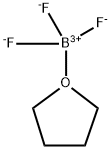
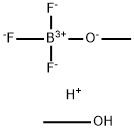
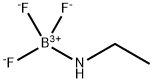
4,4-Difluoropiperidine hydrochloride tert-butyl 9-methoxy-3-azaspiro[5.5]undecane-3-carboxylate Indole Methyl Resin N-Isopropylurea N,N-Dicyclohexylcarbodiimide(DCC) MELDRUMS ACID 5-METHYLISOXAZOLE-4-CARBOXYLIC ACID Magnessium Bis glycinate Zinc ascorbate 1-bromo-2-butyne 2-acetamidophenol 9(10H)-anthracenone Erythrosin B, 4-Piperidinopiperidine 2-((4-morpholinophenylamino) (methylthio) methylene) malononitrile 2,4-dihydroxybenzaldehyde 3-(4-morpholinophenylamino)-5-amino-1H-pyrazole-4-carbonitrile Methyl 2-methylquinoline-6-carboxylate 2,6-dichloro-4-nitropyridine 4-Bromo-2-chlorobenzonitrile 2-(benzylamino)acetic acid hydrochloride 4-(tert-Butoxycarbonylamino)but- 2-ynoic acid 3,4-dihydro-2H-benzo[b][1,4]dioxepine 1-Phenyl-1-cycloprppanecarboxylicacidRelated products of tetrahydrofuran


You may like
-
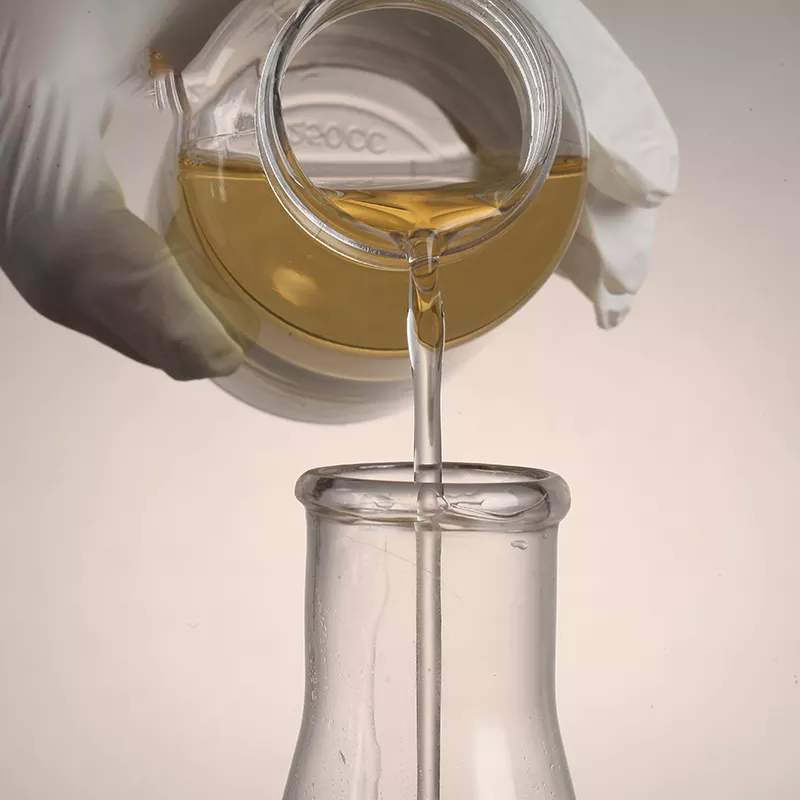 373-61-5 BF3 Acetic Acid 98%View Details
373-61-5 -
 373-61-5 98%View Details
373-61-5 -
 373-61-5 Boron trifluoride-acetic acid complex 98%View Details
373-61-5 -
373-61-5 Boron trifluoride acetic acid complex 99%View Details
373-61-5 -
Boron trifluoride acetic acid complex CAS 373-61-5View Details
373-61-5 -
Boron trifluoride acetic acid complex CAS 373-61-5View Details
373-61-5 -
20677-73-0 (2,2-diethoxyethyl)methylamine 98%View Details
20677-73-0 -
3-(4-(hydroxyamino)-1-oxoisoindolin-2-yl)piperidine-2,6-dione 98%View Details
Statement: All products displayed on this website are only used for non medical purposes such as industrial applications or scientific research, and cannot be used for clinical diagnosis or treatment of humans or animals. They are not medicinal or edible.