
N,N-Diethylformamide
Synonym(s):Formic acid diethylamide;N,N-Diethylformamide
- CAS NO.:617-84-5
- Empirical Formula: C5H11NO
- Molecular Weight: 101.15
- MDL number: MFCD00003287
- EINECS: 210-533-2
- SAFETY DATA SHEET (SDS)
- Update Date: 2025-09-25 17:15:13
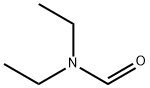
What is N,N-Diethylformamide?
Chemical properties
clear colorless to pale yellow liquid
The Uses of N,N-Diethylformamide
N,N-Diethylformamide is used in the synthesis of metal-organic frameworks and Diethyltrifluoromethylamine. It is also used as solvent in the preparation of porous cubic-shaped zinc oxide particles. It is involved in the preparation of quinazoline-2,4(1H,3H)-dione by reacting with o-aminonitrile.
The Uses of N,N-Diethylformamide
N,N-Diethylformamide was used in the synthesis of metal-organic frameworks. It was also used as solvent in the synthesis of porous cubic-shaped ZnO particles.
Definition
ChEBI: N,N-diethyl-Formamide is a carboxamide.
General Description
N,N-Diethylformamide undergoes condensation with aromatic o-aminonitriles in the presence of ZnCl2 in sealed reactor to yield quinazoline-2,4(1H,3H)-dione.
Properties of N,N-Diethylformamide
| Melting point: | 176-177°C |
| Boiling point: | 176-177 °C (lit.) |
| Density | 0.908 g/mL at 25 °C (lit.) |
| refractive index | n |
| Flash point: | 141 °F |
| storage temp. | Store below +30°C. |
| solubility | Miscible with acetone, benzene, alcohol and ether. |
| form | Liquid |
| pka | -0.44±0.70(Predicted) |
| color | Clear colorless to pale yellow |
| BRN | 1209392 |
| Dielectric constant | 29.02 |
| CAS DataBase Reference | 617-84-5(CAS DataBase Reference) |
| EPA Substance Registry System | Formamide, N,N-diethyl- (617-84-5) |
Safety information for N,N-Diethylformamide
| Signal word | Warning |
| Pictogram(s) |
 Flame Flammables GHS02  Exclamation Mark Irritant GHS07 |
| GHS Hazard Statements |
H226:Flammable liquids H315:Skin corrosion/irritation H319:Serious eye damage/eye irritation H335:Specific target organ toxicity, single exposure;Respiratory tract irritation |
| Precautionary Statement Codes |
P210:Keep away from heat/sparks/open flames/hot surfaces. — No smoking. P233:Keep container tightly closed. P240:Ground/bond container and receiving equipment. P241:Use explosion-proof electrical/ventilating/lighting/…/equipment. P303+P361+P353:IF ON SKIN (or hair): Remove/Take off Immediately all contaminated clothing. Rinse SKIN with water/shower. P305+P351+P338:IF IN EYES: Rinse cautiously with water for several minutes. Remove contact lenses, if present and easy to do. Continuerinsing. |
Computed Descriptors for N,N-Diethylformamide
| InChIKey | SUAKHGWARZSWIH-UHFFFAOYSA-N |
New Products
Indole Methyl Resin tert-butyl 9-methoxy-3-azaspiro[5.5]undecane-3-carboxylate Boc-His(Boc)-OH 2-CTC Resin 4-Chloro-7-tosy1-7Hpyrrolo[2,3-d]pyrimidine 5,7-Dibromo-1H-indole 2,5-dichloro-N-hydroxy-4,6-dimethylpyridine-3-carboximidamide 2,2-Dimethoxy-7-azaspiro[3.5]nonane hydrochloride 4-chloromethyl-5-methyl-1,3-dioxol-2-one (DMDO-Cl) R-2-BENZYLOXY PROPIONIC ACID 1,1’-CARBONYLDIIMIDAZOLE 1,1’-CARBONYLDI (1,2-4 TRIAZOLE) N-METHYL INDAZOLE-3-CARBOXYLIC ACID 4-((2-hydroxyethyl)thio)benzoic acid 1-(TERT-BUTOXYCARBONYL)-2-PYRROLIDINONE Methyl 6-methylnicotinate 3-Pyridineacrylic acid tert-Butyl carbazate TETRAHYDRO-2H-PYRAN-3-OL 2-((4-morpholinophenylamino) (methylthio) methylene) malononitrile 3-(4-morpholinophenylamino)-5-amino-1H-pyrazole-4-carbonitrile 2,4-dihydroxybenzaldehyde 1,3-Diethyl-1,3-Diphenylurea Methyl 2-methylquinoline-6-carboxylateRelated products of tetrahydrofuran


You may like
-
 N,N-Diethylformamide CAS 617-84-5View Details
617-84-5 -
N,N-Diethylformamide >99% (GC) CAS 617-84-5View Details
617-84-5 -
N,N-Diethylformamide [for Biochemical Research] CAS 617-84-5View Details
617-84-5 -
N,N-Diethylformamide CAS 617-84-5View Details
617-84-5 -
N,N-Diethylformamide CAS 617-84-5View Details
617-84-5 -
 Pyridine 99.5% HPLC /UV SpectroscopyView Details
110-86-1 -
 Dibutyl PhthalateView Details
84-74-2 -
 Thiourea 99% ARView Details
62-56-6
Statement: All products displayed on this website are only used for non medical purposes such as industrial applications or scientific research, and cannot be used for clinical diagnosis or treatment of humans or animals. They are not medicinal or edible.