
Isophthaloyl dichloride
Synonym(s):Isophthaloyl chloride;Isophthaloyl dichloride
- CAS NO.:99-63-8
- Empirical Formula: C8H4Cl2O2
- Molecular Weight: 203.02
- MDL number: MFCD00000678
- EINECS: 202-774-7
- SAFETY DATA SHEET (SDS)
- Update Date: 2025-09-25 17:15:13
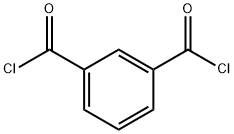
What is Isophthaloyl dichloride?
Chemical properties
white crystalline mass
The Uses of Isophthaloyl dichloride
Isophthaloyl dichloride is used in a variety of performance polymers and fibers, where it impacts flame resistance, temperature stability, chemical resistance, and flexibility. In addition, it is an effective stabilizer for urethane prepolymers due to its ability to scavenge water. Also used in aromatic fiber raw materials.
The Uses of Isophthaloyl dichloride
Intermediate, dyes, synthetic fibers, resins, films, protective coatings, laboratory reagent.
General Description
Isopthaloyl chloride acts as a crosslinking agent in various polymerization reactions.
Flammability and Explosibility
Non flammable
Properties of Isophthaloyl dichloride
| Melting point: | 43-44 °C(lit.) |
| Boiling point: | 276 °C(lit.) |
| Density | 1,388 g/cm3 |
| vapor pressure | 0.03 mm Hg ( 25 °C) |
| refractive index | 1.5700 (estimate) |
| Flash point: | 356 °F |
| storage temp. | Store below +30°C. |
| form | Crystalline Mass |
| color | White |
| explosive limit | 1.5-8.9%(V) |
| Water Solubility | reacts |
| Sensitive | Moisture Sensitive |
| BRN | 638342 |
| CAS DataBase Reference | 99-63-8(CAS DataBase Reference) |
| NIST Chemistry Reference | 1,3-Benzenedicarbonyl dichloride(99-63-8) |
| EPA Substance Registry System | 1,3-Benzenedicarbonyl dichloride (99-63-8) |
Safety information for Isophthaloyl dichloride
| Signal word | Danger |
| Pictogram(s) |
 Corrosion Corrosives GHS05  Skull and Crossbones Acute Toxicity GHS06 |
| GHS Hazard Statements |
H312:Acute toxicity,dermal H314:Skin corrosion/irritation H331:Acute toxicity,inhalation |
| Precautionary Statement Codes |
P260:Do not breathe dust/fume/gas/mist/vapours/spray. P271:Use only outdoors or in a well-ventilated area. P280:Wear protective gloves/protective clothing/eye protection/face protection. P303+P361+P353:IF ON SKIN (or hair): Remove/Take off Immediately all contaminated clothing. Rinse SKIN with water/shower. P305+P351+P338:IF IN EYES: Rinse cautiously with water for several minutes. Remove contact lenses, if present and easy to do. Continuerinsing. |
Computed Descriptors for Isophthaloyl dichloride
| InChIKey | FDQSRULYDNDXQB-UHFFFAOYSA-N |
Isophthaloyl dichloride manufacturer
New Products
4,4-Difluoropiperidine hydrochloride tert-butyl 9-methoxy-3-azaspiro[5.5]undecane-3-carboxylate Indole Methyl Resin N-Isopropylurea N,N-Dicyclohexylcarbodiimide(DCC) MELDRUMS ACID 5-METHYLISOXAZOLE-4-CARBOXYLIC ACID Magnessium Bis glycinate Zinc ascorbate 1-bromo-2-butyne 2-acetamidophenol 9(10H)-anthracenone Erythrosin B, 4-Piperidinopiperidine 2-((4-morpholinophenylamino) (methylthio) methylene) malononitrile 2,4-dihydroxybenzaldehyde 3-(4-morpholinophenylamino)-5-amino-1H-pyrazole-4-carbonitrile Methyl 2-methylquinoline-6-carboxylate 2,6-dichloro-4-nitropyridine 4-Bromo-2-chlorobenzonitrile 2-(benzylamino)acetic acid hydrochloride 4-(tert-Butoxycarbonylamino)but- 2-ynoic acid 3,4-dihydro-2H-benzo[b][1,4]dioxepine 1-Phenyl-1-cycloprppanecarboxylicacidRelated products of tetrahydrofuran
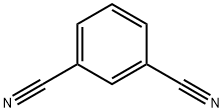
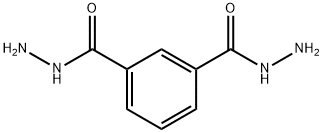
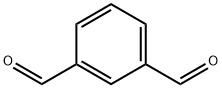
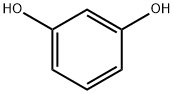


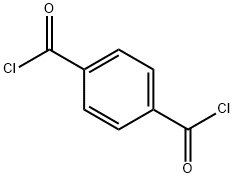

You may like
-
 m-phthaloyl chloride 99-63-8 99%View Details
99-63-8 -
Isophthaloyl dichloride CAS 99-63-8View Details
99-63-8 -
Isophthaloyl Chloride pure CAS 99-63-8View Details
99-63-8 -
Isophthaloyl chloride, ≥99% CAS 99-63-8View Details
99-63-8 -
Isophthaloyl Chloride CAS 99-63-8View Details
99-63-8 -
Isophthaloyl Chloride pure CAS 99-63-8View Details
99-63-8 -
Isophthaloyl dichloride CAS 99-63-8View Details
99-63-8 -
Isophthaloyl chloride CAS 99-63-8View Details
99-63-8
Statement: All products displayed on this website are only used for non medical purposes such as industrial applications or scientific research, and cannot be used for clinical diagnosis or treatment of humans or animals. They are not medicinal or edible.