
DIPHENOXYLATE HYDROCHLORIDE
- CAS NO.:3810-80-8
- Empirical Formula: C30H33ClN2O2
- Molecular Weight: 489.05
- MDL number: MFCD00058213
- EINECS: 223-287-6
- SAFETY DATA SHEET (SDS)
- Update Date: 2025-01-27 09:38:02
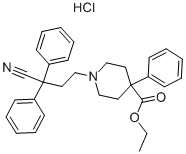
What is DIPHENOXYLATE HYDROCHLORIDE?
Chemical properties
White or almost white, crystalline powder.
Originator
Lomotil,Searle,US,1960
The Uses of DIPHENOXYLATE HYDROCHLORIDE
Antiperistaltic; antidiarrheal. Controlled substance (opiate).
Definition
ChEBI: The hydrochloride salt of diphenoxylate.
Manufacturing Process
A mixture of 23 parts of the ethyl ester of 4-phenylisonipecotic acid and 15
parts of 2,2-diphenyl-4-
omobutyronitrile in 19 parts of xylene is heated for
24 hours at 100-120°C and then cooled and filtered to remove the precipitate
of the hydro
omide of the ethyl ester of 4-phenylisonipecotic acid. The
filtrate is then extracted with dilute hydrochloric acid and the extract is
rendered alkaline by addition of concentrated aqueous potassium hydroxide
and extracted with ether. This ether extract is treated with gaseous hydrogen
chloride. The resulting precipitate is collected on a filter. The hydrochloride of
the ethyl ester of 2,2-diphenyl-4-(4'-carboxy-4'-phenyl-1'-
piperidino)butyronitrile thus obtained melts at about 220.5-222°C. See
meperidine hydrochloride for synthesis of 4-phenyl-isonipecotic acid ethyl
ester.
Therapeutic Function
Antidiarrheal
Veterinary Drugs and Treatments
Diphenoxylate is an opiate in combination with atropine in antidiarrheal products used primarily in dogs; it also has antitussive properties. Use in cats is controversial and many clinicians do not recommend its use in this species.
Properties of DIPHENOXYLATE HYDROCHLORIDE
| Melting point: | 220.5-222° |
| storage temp. | -20°C |
| solubility | Very slightly soluble in water, freely soluble in methylene chloride, sparingly soluble in ethanol (96 per cent). |
| form | Solid |
| color | White to Off-White |
Safety information for DIPHENOXYLATE HYDROCHLORIDE
| Signal word | Danger |
| Pictogram(s) |
 Skull and Crossbones Acute Toxicity GHS06  Health Hazard GHS08 |
| GHS Hazard Statements |
H301:Acute toxicity,oral H317:Sensitisation, Skin H334:Sensitisation, respiratory |
| Precautionary Statement Codes |
P262:Do not get in eyes, on skin, or on clothing. P280:Wear protective gloves/protective clothing/eye protection/face protection. |
Computed Descriptors for DIPHENOXYLATE HYDROCHLORIDE
New Products
Indole Methyl Resin tert-butyl 9-methoxy-3-azaspiro[5.5]undecane-3-carboxylate Boc-His(Boc)-OH 2-CTC Resin 4-Chloro-7-tosy1-7Hpyrrolo[2,3-d]pyrimidine 5,7-Dibromo-1H-indole 2,5-dichloro-N-hydroxy-4,6-dimethylpyridine-3-carboximidamide 2,2-Dimethoxy-7-azaspiro[3.5]nonane hydrochloride 4-chloromethyl-5-methyl-1,3-dioxol-2-one (DMDO-Cl) R-2-BENZYLOXY PROPIONIC ACID 1,1’-CARBONYLDIIMIDAZOLE 1,1’-CARBONYLDI (1,2-4 TRIAZOLE) N-METHYL INDAZOLE-3-CARBOXYLIC ACID 4-((2-hydroxyethyl)thio)benzoic acid 1-(TERT-BUTOXYCARBONYL)-2-PYRROLIDINONE Methyl 6-methylnicotinate 3-Pyridineacrylic acid tert-Butyl carbazate TETRAHYDRO-2H-PYRAN-3-OL 2-((4-morpholinophenylamino) (methylthio) methylene) malononitrile 3-(4-morpholinophenylamino)-5-amino-1H-pyrazole-4-carbonitrile 2,4-dihydroxybenzaldehyde 1,3-Diethyl-1,3-Diphenylurea Methyl 2-methylquinoline-6-carboxylateRelated products of tetrahydrofuran

You may like
-
 Diphenoxylate hydrochloride 3810-80-8 99%View Details
3810-80-8 -
 Pyridine 99.5% HPLC /UV SpectroscopyView Details
110-86-1 -
 Guanine , 99%View Details
73-40-5 -
 Piperazine Spot supply, best priceView Details
110-85-0 -
 Dibutyl PhthalateView Details
84-74-2 -
 Imidazole Spot supply, competitive priceView Details
288-32-4 -
 Octadecyl 3-(3,5-di-tert-butyl-4-hydroxyphenyl)propionate 98% (GC)View Details
2082-79-3 -
 Thiourea 99% ARView Details
62-56-6