
DIOCTADECYLAMINE
Synonym(s):Distearylamine;DODA
- CAS NO.:112-99-2
- Empirical Formula: C36H75N
- Molecular Weight: 521.99
- MDL number: MFCD00048494
- EINECS: 204-020-2
- SAFETY DATA SHEET (SDS)
- Update Date: 2025-01-27 09:38:02

What is DIOCTADECYLAMINE?
The Uses of DIOCTADECYLAMINE
Dioctadecylamine (DODA) is suitable reagent used in the synthesis of the following:
- Dioctadecylamine-BCN (bicyclo[6.1.0]nonyne) conjugate.
- Lipid derivatives of bisethylnorspermine (BSP).
- Functional VP (N-vinylpyrrolidone ) polymers.
- As a reactant in the synthesis of 4,4′-azobis(4-cyano-N,N-dioctadecyl)pentanamide (DODA-501) by reacting with disuccinimidyl 4,4′-azobis(4-cyanovalerate).
- As a reagent in the synthesis of dioctadecyl heptapeptides.
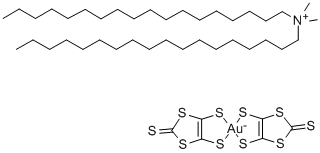
- As a phase transfer and stabilizer agent for gold nanoparticles (AuNPs) in non-polar solvent.
General Description
Dioctadecylamine (DODA), a secondary amine, is a fatty amine derivative. Its biodegradation potential has been assessed. It has been observed that in aqueous medium DODA self organizes into plate like structures. Its partial charge distribution as a function of its conformation has been analyzed. The phase diagram of dioctadecylamine Langmuir monolayers has been determined and investigations show it does not form a monolayer above pH 3.9. DODA has been utilized in forming liposomes, cationic lipids or lipid chelating agents.
Properties of DIOCTADECYLAMINE
| Melting point: | 71-73 °C |
| Boiling point: | 524.75°C (estimate) |
| Density | 0.9086 (estimate) |
| refractive index | 1.4841 (estimate) |
| solubility | water: soluble(lit.) |
| pka | 10.84±0.19(Predicted) |
| BRN | 1801688 |
| EPA Substance Registry System | 1-Octadecanamine, N-octadecyl- (112-99-2) |
Safety information for DIOCTADECYLAMINE
| Signal word | Warning |
| Pictogram(s) |
 Exclamation Mark Irritant GHS07 |
| GHS Hazard Statements |
H315:Skin corrosion/irritation H319:Serious eye damage/eye irritation H335:Specific target organ toxicity, single exposure;Respiratory tract irritation |
| Precautionary Statement Codes |
P261:Avoid breathing dust/fume/gas/mist/vapours/spray. P264:Wash hands thoroughly after handling. P264:Wash skin thouroughly after handling. P271:Use only outdoors or in a well-ventilated area. P280:Wear protective gloves/protective clothing/eye protection/face protection. P302+P352:IF ON SKIN: wash with plenty of soap and water. P305+P351+P338:IF IN EYES: Rinse cautiously with water for several minutes. Remove contact lenses, if present and easy to do. Continuerinsing. |
Computed Descriptors for DIOCTADECYLAMINE
New Products
Indole Methyl Resin tert-butyl 9-methoxy-3-azaspiro[5.5]undecane-3-carboxylate Boc-His(Boc)-OH 2-CTC Resin 4-Chloro-7-tosy1-7Hpyrrolo[2,3-d]pyrimidine 5,7-Dibromo-1H-indole 2,5-dichloro-N-hydroxy-4,6-dimethylpyridine-3-carboximidamide 2,2-Dimethoxy-7-azaspiro[3.5]nonane hydrochloride 4-chloromethyl-5-methyl-1,3-dioxol-2-one (DMDO-Cl) R-2-BENZYLOXY PROPIONIC ACID 1,1’-CARBONYLDIIMIDAZOLE 1,1’-CARBONYLDI (1,2-4 TRIAZOLE) N-METHYL INDAZOLE-3-CARBOXYLIC ACID 4-((2-hydroxyethyl)thio)benzoic acid 1-(TERT-BUTOXYCARBONYL)-2-PYRROLIDINONE Methyl 6-methylnicotinate 3-Pyridineacrylic acid tert-Butyl carbazate TETRAHYDRO-2H-PYRAN-3-OL 2-((4-morpholinophenylamino) (methylthio) methylene) malononitrile 3-(4-morpholinophenylamino)-5-amino-1H-pyrazole-4-carbonitrile 2,4-dihydroxybenzaldehyde 1,3-Diethyl-1,3-Diphenylurea Methyl 2-methylquinoline-6-carboxylateRelated products of tetrahydrofuran







You may like
-
 Dioctadecylamine CAS 112-99-2View Details
112-99-2 -
 Pyridine 99.5% HPLC /UV SpectroscopyView Details
110-86-1 -
 Guanine , 99%View Details
73-40-5 -
 Piperazine Spot supply, best priceView Details
110-85-0 -
 Dibutyl PhthalateView Details
84-74-2 -
 Imidazole Spot supply, competitive priceView Details
288-32-4 -
 Octadecyl 3-(3,5-di-tert-butyl-4-hydroxyphenyl)propionate 98% (GC)View Details
2082-79-3 -
 Thiourea 99% ARView Details
62-56-6
Statement: All products displayed on this website are only used for non medical purposes such as industrial applications or scientific research, and cannot be used for clinical diagnosis or treatment of humans or animals. They are not medicinal or edible.