
BOC-L-Proline
Synonym(s):N-(tert-Butoxycarbonyl)-L -proline;Boc-L -proline;Boc-Pro-OH;N-α-t.-Boc-L-proline
- CAS NO.:15761-39-4
- Empirical Formula: C10H17NO4
- Molecular Weight: 215.25
- MDL number: MFCD00037324
- EINECS: 239-848-3
- SAFETY DATA SHEET (SDS)
- Update Date: 2025-08-20 16:56:13
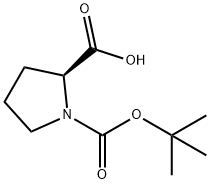
What is BOC-L-Proline?
Description
N-Boc-L-proline is a synthetic intermediate. It has been used in the synthesis of enantioselective catalysts for aldol reactions and hepatitis C virus (HCV) NS5A inhibitors.
Chemical properties
White to off-white microcrystalline powder
The Uses of BOC-L-Proline
N-Boc-L-proline is used as an intermediate in organic synthesis. It is also used to prepare daclatasvir, which inhibits the hepatitis C virus (HCV) non-structural 5A (NS5A) protein. Further, it is used as a drug in the treatment of hepatitis C virus (HCV).
What are the applications of Application
Boc-Pro-OH is a useful synthetic intermediate
Preparation
Triethylamine (16.5 mL, 0.12 mmol) was added dropwise over a period of 10 min to a stirred, ice-cold suspension of l-proline (10.0 g, 8.7 mmol) in dichloromethane (200 mL) in a 500-mL three-necked, round-bottomed flask. A solution of Boc2O (28.3 g, 0.13 mmol) in dichloromethane (100 mL) was then added over a period of 10 min and the mixture was stirred for 2.5 h. Thereafter, 10% aqueous citric acid (50 mL) was added, and the dichloromethane layer was washed with saturated brine (2×50 mL) and with water (50 mL). After drying the organic phase over magnesium sulfate, the solvent was evaporated and the residue was taken up in hot ethyl acetate. Dilution of this solution with hexane gave the product, N-tertbutoxycarbonyl- L-proline (17.8 g, 95%); mp 138–140℃; TLC (silica gel): Rf=0:36 (EtOAc/MeOH, 1:1).
Properties of BOC-L-Proline
| Melting point: | 133-135 °C(lit.) |
| Boiling point: | 355.52°C (rough estimate) |
| alpha | -60.5 º (c=1, HAc) |
| Density | 1.1835 (rough estimate) |
| refractive index | -60 ° (C=2, AcOH) |
| storage temp. | Keep in dark place,Sealed in dry,Room Temperature |
| solubility | Soluble in acetic acid. |
| form | Crystals or Crystalline Powder |
| pka | 4.01±0.20(Predicted) |
| color | White |
| optical activity | [α]20/D 61±2°, c = 2% in acetic acid |
| BRN | 15828 |
| CAS DataBase Reference | 15761-39-4(CAS DataBase Reference) |
| EPA Substance Registry System | 1,2-Pyrrolidinedicarboxylic acid, 1-(1,1-dimethylethyl) ester, (2S)- (15761-39-4) |
Safety information for BOC-L-Proline
| Signal word | Warning |
| Pictogram(s) |
 Exclamation Mark Irritant GHS07 |
| GHS Hazard Statements |
H315:Skin corrosion/irritation H319:Serious eye damage/eye irritation H335:Specific target organ toxicity, single exposure;Respiratory tract irritation |
| Precautionary Statement Codes |
P261:Avoid breathing dust/fume/gas/mist/vapours/spray. P305+P351+P338:IF IN EYES: Rinse cautiously with water for several minutes. Remove contact lenses, if present and easy to do. Continuerinsing. |
Computed Descriptors for BOC-L-Proline
| InChIKey | ZQEBQGAAWMOMAI-ZETCQYMHSA-N |
BOC-L-Proline manufacturer
SUMUKHA LIFESCIENCES
NSR Amino Organics
Nandana Bioscience (OPC) Private Limited
ASM Organics
New Products
Indole Methyl Resin tert-butyl 9-methoxy-3-azaspiro[5.5]undecane-3-carboxylate Boc-His(Boc)-OH 2-CTC Resin 4-Chloro-7-tosy1-7Hpyrrolo[2,3-d]pyrimidine 5,7-Dibromo-1H-indole 2,5-dichloro-N-hydroxy-4,6-dimethylpyridine-3-carboximidamide 2,2-Dimethoxy-7-azaspiro[3.5]nonane hydrochloride 4-chloromethyl-5-methyl-1,3-dioxol-2-one (DMDO-Cl) R-2-BENZYLOXY PROPIONIC ACID 1,1’-CARBONYLDIIMIDAZOLE 1,1’-CARBONYLDI (1,2-4 TRIAZOLE) N-METHYL INDAZOLE-3-CARBOXYLIC ACID 4-((2-hydroxyethyl)thio)benzoic acid 1-(TERT-BUTOXYCARBONYL)-2-PYRROLIDINONE Methyl 6-methylnicotinate 3-Pyridineacrylic acid tert-Butyl carbazate TETRAHYDRO-2H-PYRAN-3-OL 2-((4-morpholinophenylamino) (methylthio) methylene) malononitrile 3-(4-morpholinophenylamino)-5-amino-1H-pyrazole-4-carbonitrile 2,4-dihydroxybenzaldehyde 1,3-Diethyl-1,3-Diphenylurea Methyl 2-methylquinoline-6-carboxylateRelated products of tetrahydrofuran


You may like
-
 BOC-L-Proline 15761-39-4 98%View Details
15761-39-4 -
 15761-39-4 98%View Details
15761-39-4 -
 15761-39-4 98%View Details
15761-39-4 -
N-Boc-L-proline >98%View Details
15761-36-4 -
BOC-L-Proline extrapure CAS 15761-39-4View Details
15761-39-4 -
Boc-L-proline CAS 15761-39-4View Details
15761-39-4 -
BOC-L-Proline CAS 15761-39-4View Details
15761-39-4 -
 C10h17no4 BOC-L-PROLINE(15761-39-4), Packaging Type: DrumView Details
15761-39-4