
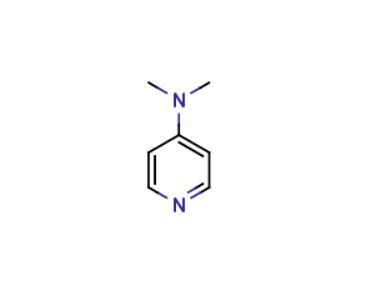
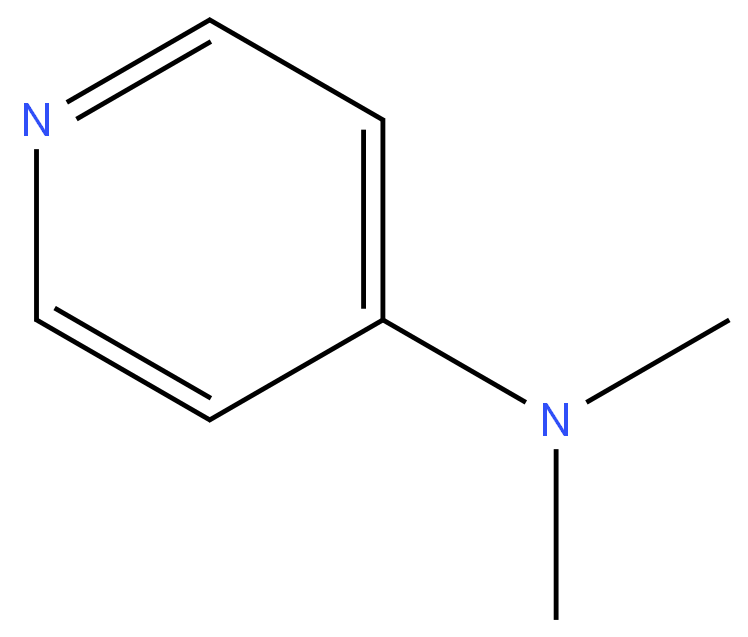
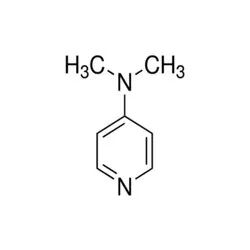
4-Dimethylaminopyridine
Synonym(s):DMAP;4-Dimethylaminopyridine;4-(Dimethylamino)pyridine;Valaciclovir Related Compound G (USP);DMAP solution
- CAS NO.:1122-58-3
- Empirical Formula: C7H10N2
- Molecular Weight: 122.17
- MDL number: MFCD00006418
- EINECS: 214-353-5
- SAFETY DATA SHEET (SDS)
- Update Date: 2025-09-25 17:15:13
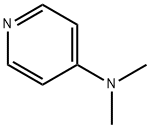
What is 4-Dimethylaminopyridine?
Description
4-(Dimethylamino)pyridine (DMAP) is a toxic, corrosive solid that is widely used as a nucleophilic catalyst in esterification, hydrosilylation, Bayliss–Hillman reactions, and many more. In 2001, G. C. Fu and co-workers showed that chiral derivatives of DMAP can be used for stereoselective catalysis. More recently,?D. Seidel and co-workers used DMAP and other inexpensive reagents in acylation reactions?to give products that can be enantiomerically resolved. DMAP is also a nucleophilic catalyst and can be used in a variety of different reactions.DMAP is used as a very efficient acyl transfer agent. Studies have shown that esterification of hindered alcohols via anhydrides can be increased by a factor of 10,000 using 4-aminopyridines such as DMAP.
Chemical properties
White solid
The Uses of 4-Dimethylaminopyridine
4-Dimethylaminopyridine is a versatile hypernucleophilic acylation catalyst, it is used to improve the yield, reduce the reaction time, improving relaxation process conditions, for a variety of reactions such as esterifications with anhydrides, the Baylis-Hillman reaction, hydrosilylations, tritylation, the Steglich rearrangement. DMAP is widely used in perfumes, dyes, pigments, pesticides, pharmaceuticals and polymer compounds and other fields.
What are the applications of Application
4-Dimethylaminopyridine is a highly efficient catalyst for acylation reactions
Definition
ChEBI: 4-Dimethylaminopyridine is a dialkylarylamine and a tertiary amino compound.
General Description
Valacyclovir Related Compound G, also called as 4-(Dimethylamino)pyridine (DMAP) is an excellent catalyst for acylation of hindered alcohols and in chemical transformations. It is highly nucleophilic in nature.
Hazard
4-Dimethylaminopyridine (4-DMAP) is readily absorbed through the skin and is highly toxic by skin absorption. It also causes skin and eye burns. All skin and eye contact and inhalation should be avoided. Appropriate OSHA/ MSHA-approved respirator, chemical-resistant gloves and impervious or disposable protective clothing should be worn. Work should be carried out in a chemical fume hood.
Hazard
4-Dimethylaminopyridine is a strong skin and eye irritant; toxic if ingested; highly toxic if absorbed through the skin.
Solubility in organics
4-Dimethylaminopyridine can be soluble in methanol, benzene, ethyl acetate, chloroform, methylene chloride, acetone, and acetic acid. Less soluble in ether, diisopropyl ether, cyclohexane, hexane, and water.
Synthesis
N-[4-Pyridyl] pyridinium chloride hydrochloride (641.0 gm, 94.99% assay, 2.657 mole) and N,N-dimethyl formamide (421 gm, 99% assay, 5.709 mole) were charged in a 2 liter round bottom flask fitted with a stirrer, thermometer pocket and double surface condenser. The reaction mass was slowly heated to reflux temperature (150 to 155° C.), and refluxing continued for 2 to 3 hours. After the completion of the reaction, pyridine was distilled off. The aqueous mother liquor obtained after alkaline hydrolysis and filtration was extracted with chloroform (2940 g×1 and 1470 g×3). A lot of emulsion was observed after extraction, which creates problem in layer separation. After extraction with chloroform, the organic phase was separated out and treated with charcoal for removing off-color impurities. Light yellow mother liquor was taken for chloroform recovery. After chloroform recovery, 700.0 gm ethyl acetate was added for the crystallization of crude 4-DMAP. After cooling to 0° C. followed by filtration, 180 g 4-DMAP, with 98.97% assay by G.C, and 54.88% yield were recovered. This clearly indicates that in spite of additional steps involved, yield and assay of the 4-DMAP is reduced compared to the process of the present invention.
Purification Methods
Recrystallise DMAP from toluene [Sadownik et al. J Am Chem Soc 108 7789 1986]. [Beilstein 22 V 112.] § A polystyrene supported version (PS-DMAP) is commercially available.
Properties of 4-Dimethylaminopyridine
| Melting point: | 112 °C |
| Boiling point: | 162 °C |
| Density | 0.906 g/mL at 25 °C |
| vapor pressure | 0.169 hPa at 20 °C |
| refractive index | n20/D 1.431 |
| Flash point: | 110 °C |
| storage temp. | Store below +30°C. |
| solubility | methanol: 50 mg/mL, clear |
| form | prilled |
| appearance | White solid |
| pka | pKa (20°): 9.7 |
| color | off-white to yellow |
| Odor | characteristic odor |
| PH | 11 (60g/l, H2O, 20℃) |
| PH Range | 9.7 (10% aq soln) |
| Water Solubility | 76 g/L (25 ºC) |
| Merck | 14,3389 |
| BRN | 110354 |
| Stability: | Stable. Incompatible with acids, oxidizing agents. |
| CAS DataBase Reference | 1122-58-3(CAS DataBase Reference) |
| NIST Chemistry Reference | 4-Pyridinamine, N,N-dimethyl-(1122-58-3) |
| EPA Substance Registry System | 4-(Dimethylamino)pyridine (1122-58-3) |
Safety information for 4-Dimethylaminopyridine
| Signal word | Danger |
| Pictogram(s) |
 Corrosion Corrosives GHS05  Skull and Crossbones Acute Toxicity GHS06  Health Hazard GHS08  Environment GHS09 |
| GHS Hazard Statements |
H310:Acute toxicity,dermal H315:Skin corrosion/irritation H318:Serious eye damage/eye irritation H370:Specific target organ toxicity, single exposure H411:Hazardous to the aquatic environment, long-term hazard |
| Precautionary Statement Codes |
P262:Do not get in eyes, on skin, or on clothing. P273:Avoid release to the environment. P280:Wear protective gloves/protective clothing/eye protection/face protection. P301+P310:IF SWALLOWED: Immediately call a POISON CENTER or doctor/physician. P305+P351+P338:IF IN EYES: Rinse cautiously with water for several minutes. Remove contact lenses, if present and easy to do. Continuerinsing. |
Computed Descriptors for 4-Dimethylaminopyridine
4-Dimethylaminopyridine manufacturer
Jaagruthi Lifesciences
SAKEM LLP
New Products
4,4-Difluoropiperidine hydrochloride tert-butyl 9-methoxy-3-azaspiro[5.5]undecane-3-carboxylate Indole Methyl Resin N-Isopropylurea N,N-Dicyclohexylcarbodiimide(DCC) MELDRUMS ACID 5-METHYLISOXAZOLE-4-CARBOXYLIC ACID Magnessium Bis glycinate Zinc ascorbate 1-bromo-2-butyne 2-acetamidophenol 9(10H)-anthracenone Erythrosin B, 4-Piperidinopiperidine 2-((4-morpholinophenylamino) (methylthio) methylene) malononitrile 2,4-dihydroxybenzaldehyde 3-(4-morpholinophenylamino)-5-amino-1H-pyrazole-4-carbonitrile Methyl 2-methylquinoline-6-carboxylate 2,6-dichloro-4-nitropyridine 4-Bromo-2-chlorobenzonitrile 2-(benzylamino)acetic acid hydrochloride 4-(tert-Butoxycarbonylamino)but- 2-ynoic acid 3,4-dihydro-2H-benzo[b][1,4]dioxepine 1-Phenyl-1-cycloprppanecarboxylicacidRelated products of tetrahydrofuran

You may like
-
 4-DimethylaminopyridineView Details
1122-58-3 -
 DMAP 98%View Details
 -
 4-Dimethylaminopyridine CASView Details
 -
 4-Dimethylaminopyridine CAS NO-1122-58-3View Details
1122-58-3 -
 4-Dimethyl Amino Pyridine CAS No. 1122-58-3, PowderView Details
1122-58-3 -
 4-(Dimethylamino)Pyridine (4-DMAP) (CAS Number: 1122-58-3)View Details
1122-58-3 -
4-dimethylaminopyridine ?1122-58-3 98%View Details
?1122-58-3 -
 4-Dimethylaminopyridine Spot supply,good priceView Details
1122-58-3