
Orelabrutinib
- CAS NO.:1655504-04-3
- Empirical Formula: C26H25N3O3
- Molecular Weight: 427.49
- MDL number: MFCD32184857
- Update Date: 2025-12-23 21:30:31
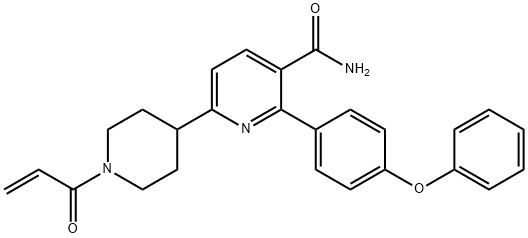
What is Orelabrutinib ?
Description
Orelabrutinib is a small molecule inhibitor of Bruton's tyrosine kinase with potential antineoplastic activity.
Description
In December 2020, orelabrutinib was approved by the China National Medical Products Administration for treating patients with relapsed/refractory MCL, CLL, and SLL. This compound is also being evaluated for the treatment of multiple sclerosis. Orelabrutinib, which has a unique pyridylcarboxamide hinge binder, showed an IC50 value of 1.6 nM in the BTK enzymatic assay. When tested against a panel of 456 kinases at 1 μM, orelabrutinib only inhibited BTK (>90%), while ibrutinib also targeted several other kinases, including EGFR, TEC, and BMX. Orelabrutinib has a favorable half-life of 4 h in healthy volunteers.1,2 It is administered orally at a daily dose of 150 mg.
The Uses of Orelabrutinib
Orelabrutinib has been previously approved to treat patients with relapsed or refractory (R/R) mantle cell lymphoma and R/R chronic lymphocytic leukemia/small lymphocytic lymphoma.
brand name
InnobrukaTM
General Description
Class: non-receptor tyrosine kinase
Treatment: CLL, SLL, MCL
Elimination half-life = 4 h
Protein binding = not reported
Biological Activity
Orelabrutinib (ICP-022) is a potent, orally active and irreversible inhibitor of Bruton's tyrosine kinase (BTK).
Mechanism of action
Upon administration, orelabrutinib binds to and inhibits the activity of BTK. This prevents both the activation of the B-cell antigen receptor (BCR) signaling pathway and BTK-mediated activation of downstream survival pathways, inhibiting the growth of malignant B-cells that overexpress BTK.
Properties of Orelabrutinib
| Boiling point: | 646.3±55.0 °C(Predicted) |
| Density | 1.213±0.06 g/cm3(Predicted) |
| form | Solid |
| pka | 14.80±0.50(Predicted) |
| color | White to off-white |
Safety information for Orelabrutinib
| Signal word | Warning |
| Pictogram(s) |
 Exclamation Mark Irritant GHS07 |
| GHS Hazard Statements |
H302:Acute toxicity,oral H315:Skin corrosion/irritation H319:Serious eye damage/eye irritation H335:Specific target organ toxicity, single exposure;Respiratory tract irritation |
| Precautionary Statement Codes |
P261:Avoid breathing dust/fume/gas/mist/vapours/spray. P305+P351+P338:IF IN EYES: Rinse cautiously with water for several minutes. Remove contact lenses, if present and easy to do. Continuerinsing. |
Computed Descriptors for Orelabrutinib
New Products
Indole Methyl Resin tert-butyl 9-methoxy-3-azaspiro[5.5]undecane-3-carboxylate Boc-His(Boc)-OH 2-CTC Resin 4-Chloro-7-tosy1-7Hpyrrolo[2,3-d]pyrimidine 5,7-Dibromo-1H-indole 2,5-dichloro-N-hydroxy-4,6-dimethylpyridine-3-carboximidamide 2,2-Dimethoxy-7-azaspiro[3.5]nonane hydrochloride 4-chloromethyl-5-methyl-1,3-dioxol-2-one (DMDO-Cl) R-2-BENZYLOXY PROPIONIC ACID 1,1’-CARBONYLDIIMIDAZOLE 1,1’-CARBONYLDI (1,2-4 TRIAZOLE) N-METHYL INDAZOLE-3-CARBOXYLIC ACID 4-((2-hydroxyethyl)thio)benzoic acid 1-(TERT-BUTOXYCARBONYL)-2-PYRROLIDINONE Methyl 6-methylnicotinate 3-Pyridineacrylic acid tert-Butyl carbazate TETRAHYDRO-2H-PYRAN-3-OL 2-((4-morpholinophenylamino) (methylthio) methylene) malononitrile 3-(4-morpholinophenylamino)-5-amino-1H-pyrazole-4-carbonitrile 2,4-dihydroxybenzaldehyde 1,3-Diethyl-1,3-Diphenylurea Methyl 2-methylquinoline-6-carboxylateRelated products of tetrahydrofuran

You may like
-
 Pyridine 99.5% HPLC /UV SpectroscopyView Details
110-86-1 -
 Guanine , 99%View Details
73-40-5 -
 Piperazine Spot supply, best priceView Details
110-85-0 -
 Potassium Hydroxide 90%View Details
1310-58-3 -
 Dibutyl PhthalateView Details
84-74-2 -
 Imidazole Spot supply, competitive priceView Details
288-32-4 -
 Octadecyl 3-(3,5-di-tert-butyl-4-hydroxyphenyl)propionate 98% (GC)View Details
2082-79-3 -
 Thiourea 99% ARView Details
62-56-6