
Octadecy trimethyl ammonium bromide
Synonym(s):C18TAB;Octadecyltrimethylammonium bromide;TMODAB
- CAS NO.:1120-02-1
- Empirical Formula: C21H46BrN
- Molecular Weight: 392.5
- MDL number: MFCD00043171
- EINECS: 214-294-5
- SAFETY DATA SHEET (SDS)
- Update Date: 2025-12-17 09:50:41
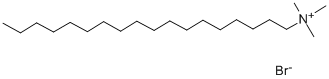
What is Octadecy trimethyl ammonium bromide?
Chemical properties
white powder
The Uses of Octadecy trimethyl ammonium bromide
A Dynamin I inhibitor.
The Uses of Octadecy trimethyl ammonium bromide
Trimethyloctadecylammonium bromide (C18TAB) is generally used as a surfactant. It can be used in the preparation of polyoxomolybdate-surfactant hybrid layered crystals. It can also be used as a surface modifier in the liquid chromatography.
What are the applications of Application
Trimethyloctadecylammonium bromide is a Dynamin I inhibitor
Flammability and Explosibility
Not classified
Purification Methods
Crystallise it from EtOH or H2O (solubility is 1 in 1000parts). It is very soluble in Me2CO. It is a bactericide. [Sheldon et al. J Am Chem Soc 68 754 1946, Grieger & Kraus J Am Chem Soc 70 3805, 38007, Beilstein 4 IV 827.]
Properties of Octadecy trimethyl ammonium bromide
| Melting point: | ~250 °C (dec.) (lit.) |
| Boiling point: | 543.31℃[at 101 325 Pa] |
| vapor pressure | 0Pa at 25℃ |
| storage temp. | Inert atmosphere,Room Temperature |
| solubility | Limited solubility |
| form | powder to crystal |
| color | White to Almost white |
| Water Solubility | soluble |
| BRN | 3574090 |
| Stability: | Stable. Hygroscopic. Incompatible with strong oxidizing agents. Protect from moisture. |
| CAS DataBase Reference | 1120-02-1(CAS DataBase Reference) |
| EPA Substance Registry System | Trimethyl-1-octylammonium bromide (1120-02-1) |
Safety information for Octadecy trimethyl ammonium bromide
| Signal word | Danger |
| Pictogram(s) |
 Corrosion Corrosives GHS05  Exclamation Mark Irritant GHS07  Environment GHS09 |
| GHS Hazard Statements |
H302:Acute toxicity,oral H315:Skin corrosion/irritation H317:Sensitisation, Skin H318:Serious eye damage/eye irritation H410:Hazardous to the aquatic environment, long-term hazard |
| Precautionary Statement Codes |
P261:Avoid breathing dust/fume/gas/mist/vapours/spray. P264:Wash hands thoroughly after handling. P264:Wash skin thouroughly after handling. P273:Avoid release to the environment. P280:Wear protective gloves/protective clothing/eye protection/face protection. P391:Collect spillage. Hazardous to the aquatic environment |
Computed Descriptors for Octadecy trimethyl ammonium bromide
New Products
Indole Methyl Resin tert-butyl 9-methoxy-3-azaspiro[5.5]undecane-3-carboxylate Boc-His(Boc)-OH 2-CTC Resin 4-Chloro-7-tosy1-7Hpyrrolo[2,3-d]pyrimidine 5,7-Dibromo-1H-indole 2,5-dichloro-N-hydroxy-4,6-dimethylpyridine-3-carboximidamide 2,2-Dimethoxy-7-azaspiro[3.5]nonane hydrochloride 4-chloromethyl-5-methyl-1,3-dioxol-2-one (DMDO-Cl) R-2-BENZYLOXY PROPIONIC ACID 1,1’-CARBONYLDIIMIDAZOLE 1,1’-CARBONYLDI (1,2-4 TRIAZOLE) N-METHYL INDAZOLE-3-CARBOXYLIC ACID 4-((2-hydroxyethyl)thio)benzoic acid 1-(TERT-BUTOXYCARBONYL)-2-PYRROLIDINONE Methyl 6-methylnicotinate 3-Pyridineacrylic acid tert-Butyl carbazate TETRAHYDRO-2H-PYRAN-3-OL 2-((4-morpholinophenylamino) (methylthio) methylene) malononitrile 3-(4-morpholinophenylamino)-5-amino-1H-pyrazole-4-carbonitrile 2,4-dihydroxybenzaldehyde 1,3-Diethyl-1,3-Diphenylurea Methyl 2-methylquinoline-6-carboxylateRelated products of tetrahydrofuran






You may like
-
 1120-02-1 Stearyl Trimethyl Ammonium Bromide 99%View Details
1120-02-1 -
 1120-02-1 98%View Details
1120-02-1 -
 Trimethylstearylammonium Bromide CAS 1120-02-1View Details
1120-02-1 -
Octadecyltrimethylammonium bromide 97% CAS 1120-02-1View Details
1120-02-1 -
Trimethyloctadecylammonium bromide CAS 1120-02-1View Details
1120-02-1 -
 Pyridine 99.5% HPLC /UV SpectroscopyView Details
110-86-1 -
 Dibutyl PhthalateView Details
84-74-2 -
 Thiourea 99% ARView Details
62-56-6
Statement: All products displayed on this website are only used for non medical purposes such as industrial applications or scientific research, and cannot be used for clinical diagnosis or treatment of humans or animals. They are not medicinal or edible.