
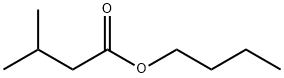
Isobutyl isovalerate
Synonym(s):2-Methylpropyl 3-methylbutyrate;Isobutyl 3-methyl butyrate
- CAS NO.:589-59-3
- Empirical Formula: C9H18O2
- Molecular Weight: 158.24
- MDL number: MFCD00048349
- EINECS: 209-653-8
- SAFETY DATA SHEET (SDS)
- Update Date: 2025-12-17 09:49:23
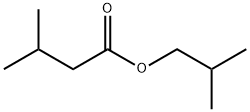
What is Isobutyl isovalerate?
Description
2-Methylpropy 1-3-methylbutyrate has an aroma reminiscent of apple/raspberry. May be prepared by oxidation of the corresponding ketone.
Chemical properties
2-Methylpropyl-3-methylbutyrate has an aroma reminiscent of apple and raspberry
Occurrence
Reported found in the oil from fruits of Xanthoxylum piperitum and in the oil of Elsholtzia ciliata. Also reported found in banana, white wine, fig, jackfruit, lamb’s lettuce and smaller galanga (Alpinium officinarum Hance).
The Uses of Isobutyl isovalerate
Flavoring and manufacture of fruit essences.
Preparation
By oxidation of the corresponding ketone.
Definition
ChEBI: 2-Methylpropyl 3-methylbutanoate is a fatty acid ester.
Taste threshold values
Taste characteristics at 20 ppm: sweet, green, fruity, banana with fresh nuances.
Properties of Isobutyl isovalerate
| Melting point: | -92.8°C (estimate) |
| Boiling point: | 168 °C |
| Density | 0.853 g/mL at 20 °C(lit.) |
| refractive index | n |
| FEMA | 3369 | 2-METHYLPROPYL 3-METHYLBUTYRATE |
| Flash point: | 57 °C |
| storage temp. | Sealed in dry,Room Temperature |
| form | clear liquid |
| color | Colorless to Almost colorless |
| Odor | at 100.00 %. sweet fruity apple raspberry green banana |
| Odor Threshold | 0.0052ppm |
| JECFA Number | 203 |
| Merck | 14,5146 |
| CAS DataBase Reference | 589-59-3(CAS DataBase Reference) |
| NIST Chemistry Reference | Iso-butyl isovalerate(589-59-3) |
| EPA Substance Registry System | Butanoic acid, 3-methyl-, 2-methylpropyl ester (589-59-3) |
Safety information for Isobutyl isovalerate
| Signal word | Warning |
| Pictogram(s) |
 Flame Flammables GHS02  Exclamation Mark Irritant GHS07 |
| GHS Hazard Statements |
H226:Flammable liquids H315:Skin corrosion/irritation |
| Precautionary Statement Codes |
P210:Keep away from heat/sparks/open flames/hot surfaces. — No smoking. P233:Keep container tightly closed. P240:Ground/bond container and receiving equipment. P264:Wash hands thoroughly after handling. P264:Wash skin thouroughly after handling. P280:Wear protective gloves/protective clothing/eye protection/face protection. P370+P378:In case of fire: Use … for extinction. P403+P235:Store in a well-ventilated place. Keep cool. P501:Dispose of contents/container to..… |
Computed Descriptors for Isobutyl isovalerate
New Products
Indole Methyl Resin tert-butyl 9-methoxy-3-azaspiro[5.5]undecane-3-carboxylate Boc-His(Boc)-OH 2-CTC Resin 4-Chloro-7-tosy1-7Hpyrrolo[2,3-d]pyrimidine 5,7-Dibromo-1H-indole 2,5-dichloro-N-hydroxy-4,6-dimethylpyridine-3-carboximidamide 2,2-Dimethoxy-7-azaspiro[3.5]nonane hydrochloride 4-chloromethyl-5-methyl-1,3-dioxol-2-one (DMDO-Cl) R-2-BENZYLOXY PROPIONIC ACID 1,1’-CARBONYLDIIMIDAZOLE 1,1’-CARBONYLDI (1,2-4 TRIAZOLE) N-METHYL INDAZOLE-3-CARBOXYLIC ACID 4-((2-hydroxyethyl)thio)benzoic acid 1-(TERT-BUTOXYCARBONYL)-2-PYRROLIDINONE Methyl 6-methylnicotinate 3-Pyridineacrylic acid tert-Butyl carbazate TETRAHYDRO-2H-PYRAN-3-OL 2-((4-morpholinophenylamino) (methylthio) methylene) malononitrile 3-(4-morpholinophenylamino)-5-amino-1H-pyrazole-4-carbonitrile 2,4-dihydroxybenzaldehyde 1,3-Diethyl-1,3-Diphenylurea Methyl 2-methylquinoline-6-carboxylateRelated products of tetrahydrofuran
You may like
-
 Isobutyl Isovalerate CAS 589-59-3View Details
589-59-3 -
Isobutyl isovalerate 97% CAS 589-59-3View Details
589-59-3 -
 Liquid Isobutyl Isovalerate CAS: 589-59-3, Grade Standard: Reagent Grade, Packaging Size: 25kgView Details
589-59-3 -
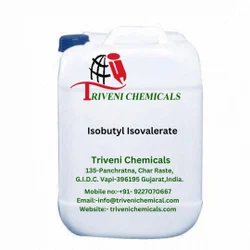 99% Min Isobutyl Isovalerate, Packaging Size: DrumView Details
589-59-3 -
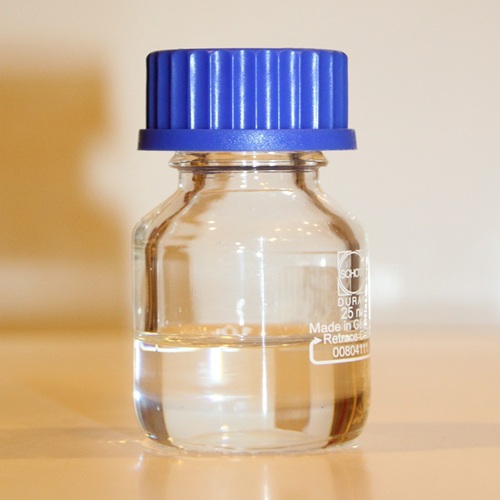 Pyridine 99.5% HPLC /UV SpectroscopyView Details
110-86-1 -
 Dibutyl PhthalateView Details
84-74-2 -
 Imidazole Spot supply, competitive priceView Details
288-32-4 -
 Thiourea 99% ARView Details
62-56-6
Statement: All products displayed on this website are only used for non medical purposes such as industrial applications or scientific research, and cannot be used for clinical diagnosis or treatment of humans or animals. They are not medicinal or edible.