
75-94-5
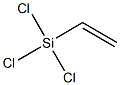
Product Name:
Trichlorovinylsilane
Formula:
C2H3Cl3Si
Synonyms:
(Trichlorosilyl)ethylene;Vinyltrichlorosilane
Inquiry
CHEMICAL AND PHYSICAL PROPERTIES
| Physical Description | Vinyltrichlorosilane appears as a colorless to pale yellow fuming liquid with a pungent odor. Vapor and liquid may cause burns. More dense than water. Vapors are heavier than air. |
|---|---|
| Color/Form | Fuming liquid |
| Odor | Sharp, choking; like hydrochloric acid |
| Boiling Point | 195.1 °F at 760 mmHg (USCG, 1999) |
| Melting Point | -139 °F (USCG, 1999) |
| Flash Point | 70 °F (NFPA, 2010) |
| Solubility | Soluble in most organic solvents |
| Density | 1.26 at 68 °F (USCG, 1999) - Denser than water; will sink |
| Vapor Density | 5.61 (Air = 1) |
| Vapor Pressure | 65.9 [mmHg] |
| Autoignition Temperature | 505 °F (USCG, 1999) |
| Decomposition | The silanes decomp at elevated temp to liberate hydrogen and deposit a high purity silicon, which leads to some of the principal uses of silanes. /Silanes/ |
| Corrosivity | Corrosive |
| Heat of Combustion | -4,300 Btu/lb = -2,400 cal/g = -100x10-5 J/kg |
| Heat of Vaporization | 88 Btu/lb = 49 cal/g = 2.0X10+5 J/kg |
| Surface Tension | 28 dynes/cm = 0.028 N/m at 20 °C |
| Polymerization | Polymerizes easily. |
| Refractive Index | Index of refraction = 1.4295 at 20 °C/D |
| Kovats Retention Index | 682.6 685 |
| Other Experimental Properties | Reacts violently with water, moist air, or steam to produce toxic and corrosive fumes |
| Chemical Classes | Toxic Gases & Vapors -> Chlorosilanes |
SAFETY INFORMATION
| Signal word | Danger |
|---|---|
| Pictogram(s) |
 Flame Flammables GHS02  Corrosion Corrosives GHS05  Skull and Crossbones Acute Toxicity GHS06 |
| GHS Hazard Statements |
H225:Flammable liquids H302:Acute toxicity,oral H314:Skin corrosion/irritation |
| Precautionary Statement Codes |
P210:Keep away from heat/sparks/open flames/hot surfaces. — No smoking. P280:Wear protective gloves/protective clothing/eye protection/face protection. P301+P312:IF SWALLOWED: call a POISON CENTER or doctor/physician IF you feel unwell. P303+P361+P353:IF ON SKIN (or hair): Remove/Take off Immediately all contaminated clothing. Rinse SKIN with water/shower. P305+P351+P338:IF IN EYES: Rinse cautiously with water for several minutes. Remove contact lenses, if present and easy to do. Continuerinsing. |
COMPUTED DESCRIPTORS
| Molecular Weight | 161.48 g/mol |
|---|---|
| Hydrogen Bond Donor Count | 0 |
| Hydrogen Bond Acceptor Count | 0 |
| Rotatable Bond Count | 0 |
| Exact Mass | 159.906960 g/mol |
| Monoisotopic Mass | 159.906960 g/mol |
| Topological Polar Surface Area | 0 Ų |
| Heavy Atom Count | 6 |
| Formal Charge | 0 |
| Complexity | 54.3 |
| Isotope Atom Count | 0 |
| Defined Atom Stereocenter Count | 0 |
| Undefined Atom Stereocenter Count | 0 |
| Defined Bond Stereocenter Count | 0 |
| Undefined Bond Stereocenter Count | 0 |
| Covalently-Bonded Unit Count | 1 |
| Compound Is Canonicalized | Yes |
PRODUCT INTRODUCTION
description
Vinyltrichlorosilane appears as a colorless to pale yellow fuming liquid with a pungent odor. Vapor and liquid may cause burns. More dense than water. Vapors are heavier than air.